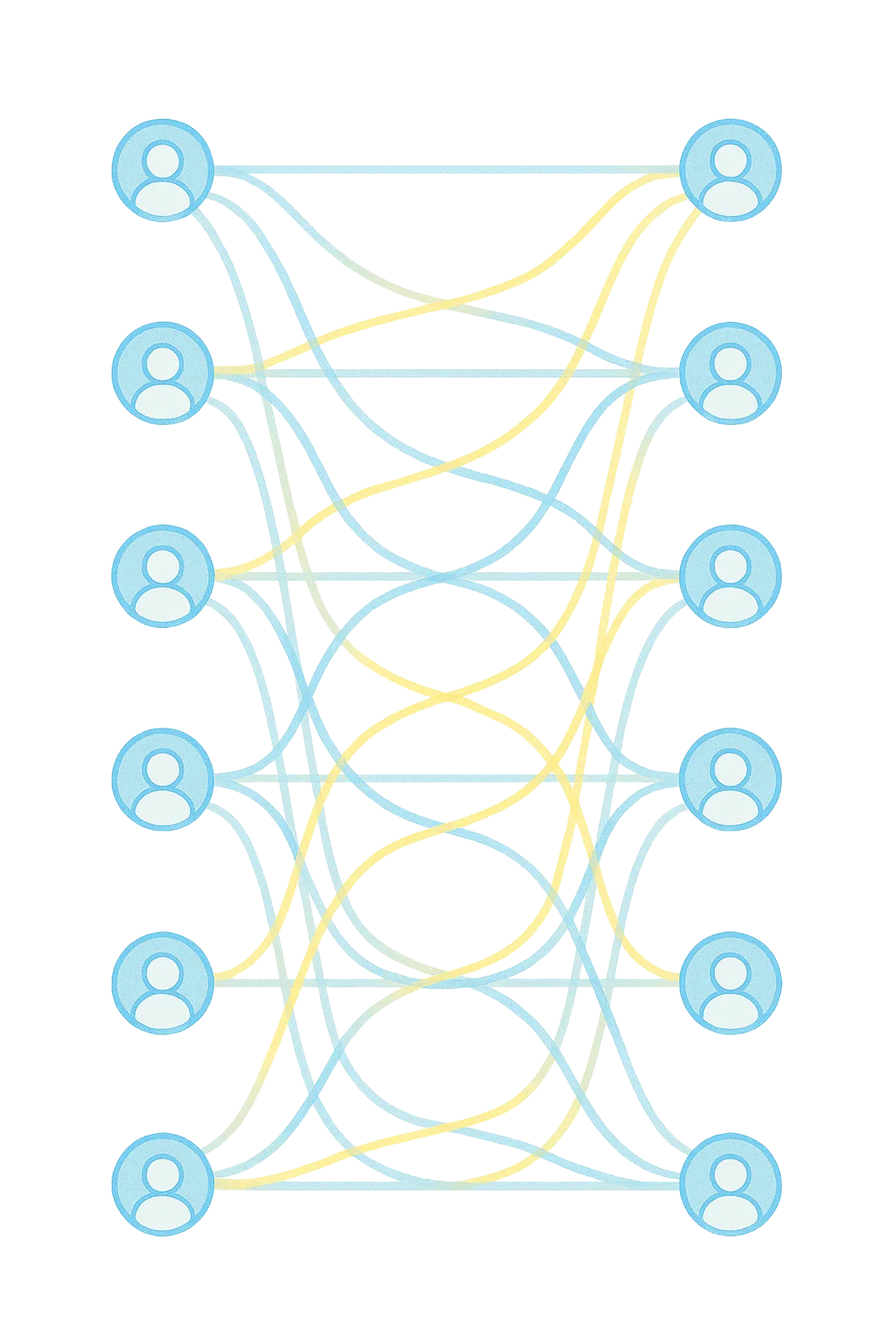
LinkedIn Is Training on Your Thought Leadership: How B2B Creators Survive the AI Feed

LinkedIn is rolling out transformer based ranking and quietly switching on default AI training using your posts, profiles, and behavior. Here is what that means for B2B creators trying to build a serious brand in an AI trained feed.
From transformer based ranking frameworks like LiGR and Brew style recommendation models to a new default policy that uses profiles and posts to train AI, LinkedIn is turning the B2B feed into an AI farm. The change is not just about privacy or opt outs. It rewires how content is scored, surfaced, and recycled. This report lays out what LinkedIn is actually doing, how the AI feed sees your content, and how B2B creators can survive and grow: designing semantically dense formats, building an anchor idea pipeline, and running a minimal LinkedIn stack for 2026 that accounts for the fact that your best posts are training the system.
LinkedIn Is Training on Your Thought Leadership: How B2B Creators Survive the AI Feed
TLDR
- LinkedIn is rolling out transformer based ranking frameworks and large recommendation models across the feed, replacing a lot of old school feature engineering with deep representation learning.
- In parallel, LinkedIn is turning on a default setting that lets it use member profiles, resumes, public posts, and activity data to train generative and ranking models in key regions from November 3, 2025 onward, unless you explicitly opt out.
- The result: LinkedIn is quietly becoming an AI training farm for your B2B content while the feed itself is increasingly AI mediated.
- Keyword hacks and timing tricks matter less; semantic density, format, and interaction patterns matter more.
- This is survivable. Treat LinkedIn as an anchor channel, build a weekly anchor idea, and turn it into a stack of posts and clips using AI editing and automation so you benefit from the same dynamics that are training on you.
No panic, no moral theater. Just a clear map of what changed and how to operate inside it.
What Actually Changed
1. The feed is moving to transformers and large recsys models
Over the last two years LinkedIn has described a shift from classic gradient boosted trees and sparse feature pipelines toward large scale transformer based ranking frameworks.
- LiGR, a large scale ranking framework presented by LinkedIn engineers in early 2025, describes how the company moved to transformer architectures that encode member profiles, posts, and interaction histories into dense representations to score what shows in the feed.
- Separate work on Brew style large language models for recommendation suggests LinkedIn is experimenting with billions of parameter models that act as a kind of general recommendation brain across jobs, feed, and other surfaces.
You do not need to memorize paper names. The important point is simple: the feed is increasingly driven by models that read meaning, not just keywords and basic engagement features.
2. Your content is now explicit AI training data by default
In September and October 2025, LinkedIn notified users in the UK, EU, EEA, Switzerland, Canada, and Hong Kong that from November 3 it will begin using member profiles, resumes, public posts, and activity to train its content generating AI models and related systems.
Key details from the updated terms and help docs:
- The setting is on by default under Data privacy – Data for generative AI improvement.
- Users can opt out, but the opt out applies only to future data; past data may remain in training sets.
- Accounts for people under 18 are excluded.
- LinkedIn frames the change as necessary to improve products such as AI assisted writing, coaching, and recommendation.
This comes on top of earlier controversy and even litigation over how member data, including messages for some premium customers, was allegedly used in AI training.
Regardless of whether you opt out, the direction of travel is clear: professional content and behavior are being fed into large models that influence the same surfaces you post on.
3. B2B content is now both product input and product output
Three overlapping pipelines now define LinkedIn:
- Ranking models that decide who sees what in the feed, in search, and in recommendations.
- Generative tools that help members write posts, comments, and messages.
- Analytics and sales tools that score accounts, leads, and opportunities.
All three are increasingly powered by AI models trained on member generated data and behavior.
You are no longer just posting into a neutral channel. You are populating the training set of systems that also generate and prioritize competing content.
How the AI Feed Actually Sees Your Content
When you hit Post, a few things happen inside an architecture like LiGR or a Brew style recommendation stack.
1. Your post becomes a vector, not a bag of keywords
The text, visuals, and metadata of your post are converted into a dense representation that encodes topics, tone, entities, and intent. Think of it as a numerical fingerprint in a high dimensional space rather than a list of words.
That vector is compared with:
- Members interests inferred from their own content and engagement.
- Company, role, and seniority information.
- Recent behavior in the session and long term patterns.
This lets the model match your post to people who should care even if you never used their exact job title or a specific keyword.
2. The model optimizes multiple objectives at once
LinkedIn ranking research describes multi objective optimization: click through rate, dwell time, reactions, comments, follows, and even longer term metrics such as session quality or propensity to return.
A simple way to read that:
- Shallow clicks or empty impressions are not enough.
- Posts that create meaningful dwell, saves, or good conversations tend to get more distribution over time.
3. Member and network context shape your ceiling
The same content can perform differently depending on who you are and who engages early.
- Connection graph: if your first wave of reactions comes from accounts that themselves drive good outcomes, your post has better odds.
- Interaction history: if your past posts were low value, the system has less prior reason to trust new ones.
- Topical consistency: repeated depth on adjacent themes trains the system to associate your profile with those themes.
The takeaway: the AI feed does not see one off stunts. It sees patterns, density, and consistency across time.
What This Means for B2B Creators
1. Keyword hacks are dead. Semantic clarity is not.
Because transformer models read semantics, stuffing posts with job title word salads does not help much. But that does not mean language no longer matters.
Instead of keyword games:
- Use precise, concrete phrasing around problems and outcomes that matter in your niche.
- Anchor a post around one atomic question or tension rather than five unrelated points.
- Repeat core terms for your category over months so the system reliably maps you to them.
Think in terms of clear topics and arguments, not trends like LinkedIn bro speak.
2. Your best posts are now training data. Act accordingly.
If you leave the default setting on, your standout posts, comments, and even profile structure become part of the corpus that teaches LinkedIns models what good looks like.
That has two implications:
- The better you get at writing, the more your style and framing patterns may be cloned in aggregate by others using AI assist features.
- You can either treat this as theft or as a tax you pay in exchange for reach and tooling.
There is no universal right answer. But pretending it does not happen is not a strategy.
3. The upside: this is a chance to ride the same wave that trains on you
The more the feed rewards semantically dense, high intent content, the more room there is for B2B creators who can:
- Explain messy realities of their category rather than posting generic motivational fluff.
- Pair real data or lived operator detail with platform fluent packaging.
- Ship consistently across formats, so the system has abundant signals on what works.
In other words, this is good news if you own a real brain and are willing to use it.
A Weekly Anchor Idea Pipeline for a LinkedIn Plus Everything World
The simplest way to stop overthinking the AI feed is to design a pipeline around one anchor idea per week.
Step 1: Pick an anchor idea that can survive compression
You want an idea that can survive being summarized, quoted, and refactored by both humans and models. Good candidates:
- A sharp observation about how your market is actually changing.
- A before and after story with numbers.
- A hard earned playbook that is not generic post this three times a week advice.
Write the idea first in plain language. No formatting. No hooks. Just the argument.
Step 2: Ship one deep LinkedIn post
Turn that argument into a flagship post that is:
- 300 to 900 words.
- Structured with a strong opening line, 3 to 5 clear sections, and a simple conclusion or next step.
- Dense with useful details: numbers, process, tooling, constraints.
Do not worry about going viral. Worry about being so specific that your ideal reader bookmarks it.
Step 3: Cut three to five short LinkedIn clips
From the same anchor idea, generate:
- One short post that is just the opening tension plus a single insight.
- One visual asset or document post summarizing the framework.
- One question style post aimed at peers, asking how they handle the same issue.
- Optional: a short native video (30 to 90 seconds) where you explain the core point to camera.
All of these should link mentally back to the same idea, but they do not all need literal links. To the model, you are reinforcing a topical cluster. To the human, you are making the idea easy to re encounter in different moments.
Step 4: Export to TikTok, Shorts, and Reels
If you are recording any talking head or screen based explainer for LinkedIn, you should not keep it there.
A realistic AI assisted workflow:
- Record a five to seven minute unscripted riff on the anchor idea on your phone or webcam.
- Use AI powered editing to:
- Transcribe and auto caption.
- Detect high energy moments and crop 9:16 cuts.
- Add consistent lower thirds and light branding.
- Export 3 to 7 clips for TikTok, Shorts, and Reels.
- Schedule them over the week while the flagship LinkedIn post is still circulating.
Tools like Rkive are built for this exact job: ingest long form footage, generate clipped, styled variants, and schedule across platforms without you babysitting timelines. The point is not which editor you use. The point is you do not want to be manually splicing the same angle into six different places.
Step 5: Close the loop with owned channels
Turn the same anchor into a short email, a blog section, or a resource on your own domain.
LinkedIn can be an acquisition layer, but your real moat is still:
- Owned audience: email list, community, or customer base.
- Owned content: site, docs, product education that lives outside rented feeds.
Minimal LinkedIn Stack for 2026
If you are a B2B creator or operator without a content team, you do not need a 40 page strategy deck. You need a small stack you can actually run.
1. Cadence
A sustainable baseline for a single person founder, consultant, or senior operator:
- 2 deep posts per week anchored in real work.
- 3 to 5 lighter touch posts per week drawn from the same or adjacent ideas.
- 3 to 7 short clips per week across LinkedIn video plus at least one other vertical platform.
- 1 monthly long form piece off platform (newsletter, blog, deep dive) that becomes future anchor material.
If you are an in house marketing team, increase volume, but keep the principle: anchor first, derivatives second.
2. Formats that play nicely with the AI feed
The transformer based feed has some structural preferences:
- Clear hierarchy in text: headings, short paragraphs, and bullet lists help both humans and models parse your post.
- Document posts with rich structure can be particularly useful because they are highly skimmable and compressible.
- Native video with burned in captions and strong opening frames tends to outperform link dumps to external webinars or YouTube uploads.
Avoid:
- Link only posts with no context.
- Generic carousels that could be about any industry.
- Pure vibe posts that do not tie back to what you actually do.
3. Analytics and feedback loops
Track three layers of signal:
- First order: views, reactions, comments, saves.
- Second order: profile visits, connection requests, message volume.
- Third order: leads, deals, inbound interviews, speaking invites.
Measure at the idea level, not the post level. Ask which anchor concepts keep spitting off meaningful second and third order outcomes.
Opt Out, Privacy, and Control
You should decide consciously whether to let LinkedIn train generative and ranking models on your content.
How to opt out (today)
LinkedIn currently provides a Data for generative AI improvement setting under Data privacy. Turning it off is the supported way to stop future posts from being used to train some AI models, though existing training sets may still contain past data.
Privacy advocates highlight that the setting is on by default, and that the justification is legitimate interest, which is similar to approaches taken by Meta and others.
If you are in a sensitive industry or share information that could reasonably be considered confidential, opt out and tighten your posting guidelines.
Should B2B creators generally opt out
A pragmatic way to think about it:
- If your LinkedIn presence is core to your pipeline and you are mostly sharing sanitized, high level insights, you may accept the training tradeoff in exchange for better AI features and a closer alignment between your niche and what LinkedIn sees as valuable content.
- If you often post quasi confidential client detail, deal structure, or internal docs even in anonymized form, you should probably opt out and rethink what belongs on a public social network.
Regardless, do not rely on platform settings for protection of genuinely sensitive information. That is what NDAs, internal wikis, and private channels are for.
FAQ for B2B Creators in an AI Trained Feed
Will AI generated content flood LinkedIn and crush my reach
To some extent, yes. Generative tools lower the cost of low quality posts. But ranking models are also incentivized to filter repetitive or engagement bait content that does not produce long term value. If anything, the more generic AI posts there are, the more your specific, operator grade content stands out.
Does posting help train models that will copy my style
At the aggregate level, yes. Your phrasing, structure, and topical clusters become a tiny part of how LinkedIn learns what good B2B content looks like. Individual style is unlikely to be reproduced one to one, but patterns absolutely bleed into AI assisted writing tools.
Is it worth posting if LinkedIn is using my posts as training data
If LinkedIn is a key source of inbound opportunities for you, yes. The expected value of client deals, speaking slots, or hires generally dwarfs the abstract cost of being part of a training set. If LinkedIn is not a major acquisition channel, you can either de invest or treat it as an index of your thinking and accept that it is also feeding models.
Can I avoid training while still benefiting from AI ranking improvements
Not entirely. Even if you opt out of generative training, your behavior still contributes to implicit signals that shape the system. Platforms rarely give users full air gap options because the models need global behavior data to work. The realistic choice is less about total withdrawal and more about what you share.
A Short Checklist for Surviving the AI Feed
- Decide your stance on training
- Check your Data privacy settings.
- Opt out if you handle sensitive work; otherwise treat it as a strategic tax.
- Commit to a weekly anchor idea
- One real, specific observation or playbook from your work.
- No platitudes.
- Ship one deep post plus three to five derivatives
- Long form, short form, doc post, and at least one short video.
- Tie them all back to the same argument.
- Automate the repurposing, not the thinking
- Use AI editing, clipping, and scheduling for the heavy lifting.
- Keep the core writing and framing human.
- Measure outcomes at idea level
- Which concepts drive profile visits, messages, deals.
- Double down there; retire topics that only farm vanity metrics.
- Build at least one owned channel in parallel
- Newsletter, community, or product content hub.
- LinkedIn should be a powerful spoke, not the entire wheel.
The AI feed is not going away. The question is whether you let it hollow you out, or treat it as an amplifier for ideas that would be worth spreading even if no model ever saw them.
Sources
-
From Features to Transformers: Redefining Ranking for Scalable Impact — LinkedIn’s own transformer-based ranking framework research (LiGR) ([arXiv][1]) https://arxiv.org/abs/2502.03417
-
LinkedIn set to start to train its AI on member profiles — announcement of default AI-training of profiles/posts from November 3 2025 (region opt-in/opt-out) ([TechRadar][2]) https://www.techradar.com/pro/linkedin-set-to-start-to-train-its-ai-on-member-profiles
-
LinkedIn to Train AI on User Profiles and Posts from November 2025 — independent coverage summarizing the change and its implications ([WebProNews][3]) https://www.webpronews.com/linkedin-to-train-ai-on-user-profiles-and-posts-from-november-2025/
-
Microsoft’s LinkedIn warns it will auto train AI models on your data, but you can opt out — another independent write-up of the announcement + opt-out mechanism ([Windows Latest][4]) https://www.windowslatest.com/2025/09/23/microsofts-linkedin-warns-it-will-auto-train-ai-models-on-your-data-but-you-can-opt-out/
-
LinkedIn Is Training AI Models on Even More User Data — regional coverage and breakdown of what data is included, opt-out instructions, etc. ([Metricool][5]) https://metricool.com/linkedin-ai-training-user-data/
-
Large Scale Retrieval for the LinkedIn Feed using Causal Language Models (arXiv preprint, Oct 2025) — shows that LinkedIn’s feed retrieval + ranking stack is now based on LLM/embedding-based systems, reinforcing the transformer-feed claim. ([arXiv][6]) https://arxiv.org/abs/2510.14223
Read more from Rkive AI
- Inside the Severance Bell Works Activation: How Apple TV+ Rewrote the Rules of Streaming Events https://rkiveai.com/resource/news/severance-apple-activation-bell-works
- Brat Summer: Inside the Messy, Maximalist Trend of the Year https://rkiveai.com/resource/news/brat-summer-messy-maximalist-trend
About the author
Alberto Luengo is the founder and CEO of Rkive AI. He writes practical, platform aware analysis focusing on content strategy, automation, analytics, and the real economics of distribution for creators, brands, and enterprises.