Descript vs Rkive AI (2026): Transcript Editor vs Content OS

If you're comparing Descript to alternatives or deciding where your 2026 content workflow should live, this is the clean, practical breakdown.
👉 Start 7-day free trial of Rkive
Prefer mobile? Rkive is also on the App Store and Google Play.
🔍 Quick Snapshot
Very short comparison, mostly yes/no.
| Feature | Descript | Rkive AI |
|---|---|---|
| Long video → short edits | ✅ Core use case | ✅ Also supported |
| Camera-roll sync | ❌ No | ✅ Yes |
| Input multiple files | ⚠️ Optimised for a few long tracks per project | ✅ Mix many short videos & images |
| Repeatable style | ✅ Templates, layouts & brand kits | ✨ Strategy-driven styling |
| Prompts | ✅ AI tools inside one project | ✅ GPT-like prompts across posts |
| Speed | ✅ ~5–10 min | ✨ <5 min |
| Cloud storage | ✅ Up to 1 TB on higher tiers | ✅ Unlimited on all plans |
| Scheduling | ❌ No | ✨ Analytics-aware auto-schedule |
| Posting | ✅ Export / publish to YouTube & podcast hosts | ✅ Auto-post any posts |
| Analytics | ❌ No | ✅ Intelligent cross-platform |
| Best fit | 🎧 Long podcasts and tutorials | 📱 Daily creators, brands & teams |
🎧 Where Descript Shines
Descript is a strong choice when your workflow looks like this:
- You publish podcasts, long YouTube videos, webinars or video lessons.
- You work mainly on laptop/desktop, comfortable in an editor UI.
- You care about sound quality, wording and pacing more than volume of daily posts.
Typical Descript workflow:
- Capture: Record directly in Descript (mic, webcam, or screen) or import a long file from another editor or call recorder.
- Transcribe: Descript autogenerates a transcript for the whole recording, with speaker labels on supported plans.
- Clean the script: Remove “um”, “uh” and other filler words in one pass, cut bad takes, reorder paragraphs — the audio and video follow your text edits.
- Refine in the timeline: Use the multitrack timeline to adjust cuts, layer B-roll, add screen recordings, slide decks, titles and captions.
- Apply AI tools: On paid plans, you can use Studio Sound for noise cleanup, Overdub/AI Speech to fix words without re-recording, “Create Clips” templates for short verticals, gap shortening, translation and more.
- Publish: Export 1080p or 4K (plan-dependent) and publish directly to YouTube or send audio to podcast hosts, or just share a review link.
Where Descript genuinely shines:
- Turning one long recording into a polished episode or talking-head video.
- Fixing delivery with filler-word removal, line rewrites and voice overdubs.
- Editing screen + camera content for tutorials and SaaS demos.
- Helping teams work in one project with comments, shared timelines and web links instead of passing exports around.
Where it’s not really designed to be the full answer:
- Building posts from dozens of short clips, photos and screenshots day after day.
- Designing carousels, infographics or social-native text posts in one place.
- Owning the entire social pipeline (calendar, auto-posting, multi-channel analytics).
It’s a production tool for: long recording → transcript edit → episode or video.
📱 What Rkive Is Designed For
Rkive exists for camera-roll-first creators, founders and brands who want the whole pipeline to feel like magic:
- You record throughout the day on your phone: talking clips, B-roll, product shots, screen grabs.
- Your raw material lives in your camera roll, not as one big project in a desktop editor.
- You want AI to handle the whole edit by default, and you just tweak the result.
Rkive behaves less like a single tool and more like a content OS: the place where your footage, edits, schedule and analytics live together.
📂 Camera-roll first + unlimited cloud
- Rkive syncs your camera roll (with your permission) on iOS and Android.
- All media and posts go into unlimited cloud storage, behaving more like a searchable content brain than individual project files.
- Your library stays in sync across web, mobile and desktop; you don’t think about transfers or exports.
🧠 Prompt-driven, intelligent editing (beyond transcripts)
With Descript, AI mostly helps you clean and reshape one recording.
With Rkive, prompts define the final post across many raw pieces:
- “Make a 35s punchy short with large subtitles and a meme cutaway when I mention price.”
- “Create a 5-slide carousel summarising these clips with bold titles and clean graphs.”
- “Turn today’s talking clips into a LinkedIn-style text post plus one supporting frame.”
Rkive’s multi-agent system decides:
- which clips and images to pull in,
- how to cut, sequence and pace them,
- where to place subtitles and overlays,
- what layouts and typography to use for the chosen format.
You describe outcomes; the system proposes a finished draft.
🎛️ Multiple files → any finished post
Rkive is built to think in posts, not projects:
- Mix:
- selfie talk clips,
- product B-roll,
- screen recordings,
- photos and screenshots.
- Output:
- short vertical videos for Reels, Shorts and TikTok,
- carousels and infographics,
- text-first posts for LinkedIn, Threads or X.
It’s tuned for daily multi-format output rather than one flagship episode.
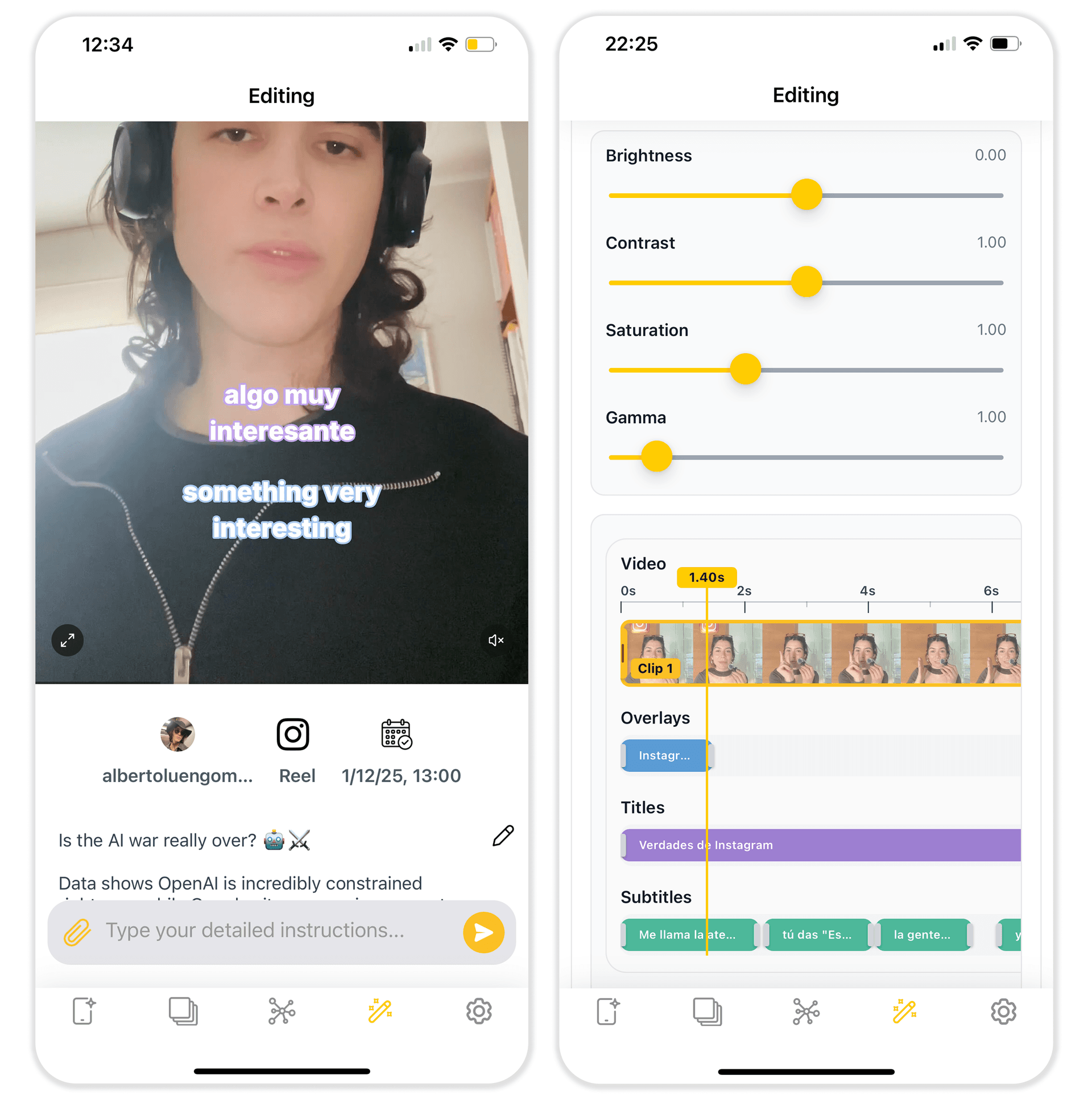
✏️ Manual control when you want it
The default is autopilot, but Rkive doesn’t lock you out:
- Open any draft in a simple timeline to tweak cuts and timing.
- Edit subtitle text, fonts and layout.
- Move or resize overlays, stickers, product shots and logos.
- Fine-tune framing, zooms and pacing when you care about the details.
You get editor-level control on top of automation, instead of having to choose between “magic button” or “full manual”.
📅 Scheduling & posting built-in
Rkive doesn’t end at export:
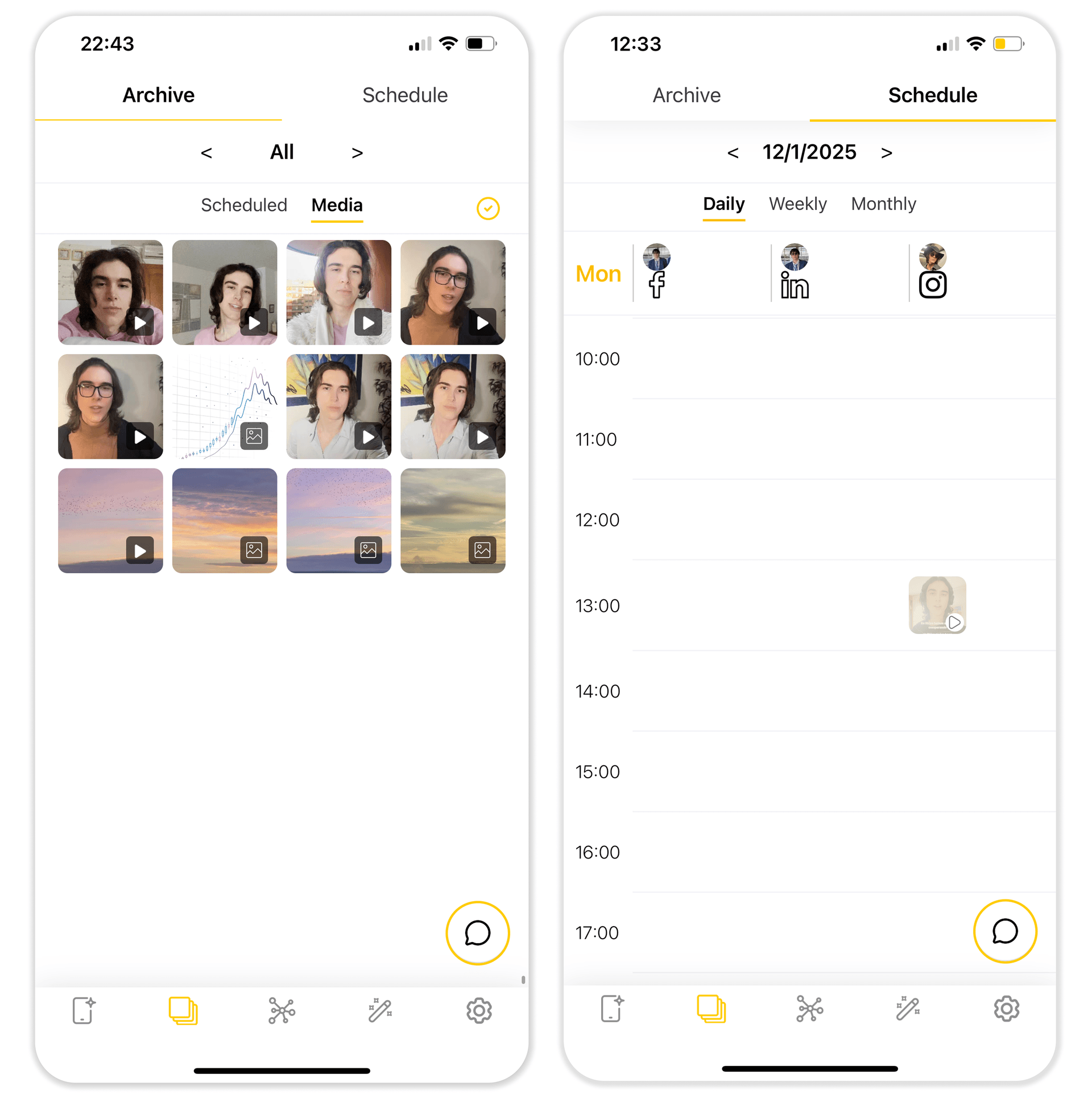
- You see a feed of your own Rkive-made posts — like your social feed, but everything is editable.
- Double-tap to schedule directly from the feed.
- Open a post to adjust copy, visuals or timing without rebuilding it.
- Use the content calendar to move slots, duplicate posts or adapt them per social account.
📊 Analytics that look at everything
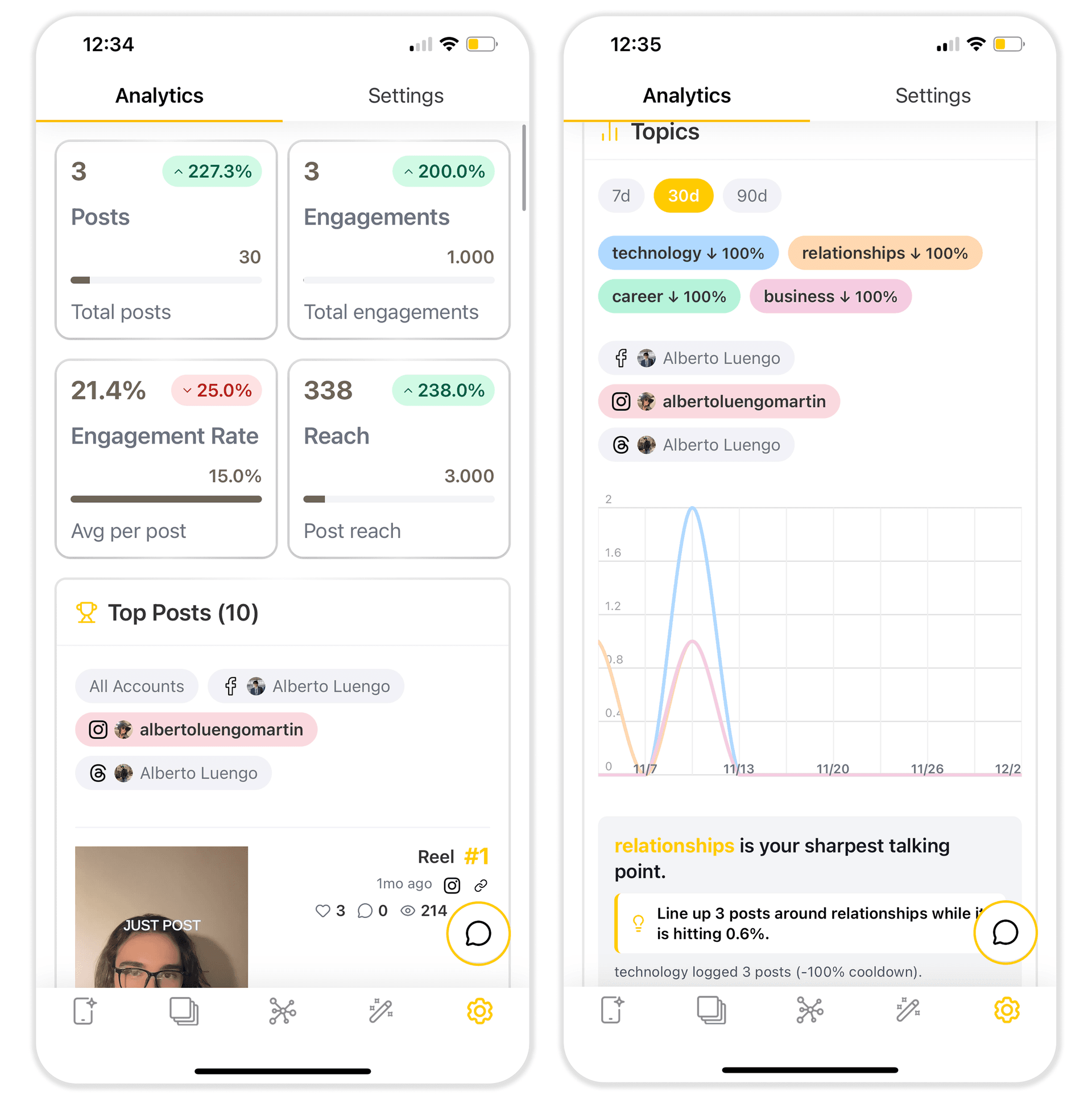
- Rkive ingests performance across your connected social accounts.
- It tracks posts created inside and outside Rkive.
- AI highlights patterns: hook types that work, best lengths, formats and posting times.
You’re not juggling dashboards; you see one cross-platform view inside the same workspace that creates the content.
💻 Works on all your devices
- Web app in the browser.
- iPhone, iPad, Android phones and tablets.
- macOS and Apple Vision Pro.
Wherever you film or review, your workspace stays synced.
📊 High-Level Feature Comparison
More detailed view for when you want to read the fine print.
| Feature / Aspect | Descript | Rkive AI |
|---|---|---|
| Primary use case | 🎧 Long recordings → edited shows & tutorials | 📱 Daily camera-roll → finished posts |
| AI editing | 🎞️ Transcript edits, filler removal, Overdub | 🧠 GPT-like prompts + AI autopilot |
| Speed | ⏳ Clip from one episode in ~5–15 min | ⚡ <5 min fully edited & exported post |
| Manual editing | ✂️ Edit the transcript to clip the video | 🎚️ Minimalist Figma-like timeline & controls |
| Input | 📥 One or a few longer files | 📂 Many clips and images |
| Short videos | 🎬 Strong for shorts & clips | 🎬 Native, plus other formats |
| Carousels & infographics | 🟥 No | 🟩 Intelligent, any style |
| Text posts | 🟥 No | 🟩 Intelligent, any style |
| Templates | 🎭 Layouts, scenes & stock media | 🧩 AI-chosen clips, gifs, stickers, web images... |
| Cloud storage | ☁️ Projects up to ~1 TB on higher tiers | ☁️ Unlimited media and posts on all plans |
| Uploads | 📥 Manual upload | 📸 Camera-roll sync, like iCloud |
| Scheduling | 🟥 No | ✨ Analytics-aware auto-schedule by double tapping |
| Posting | 📤 Publish to YouTube & audio hosts | 📤 Auto-post any format across major platforms |
| Analytics | 🟥 No | 📊 AI & cross-platform, including non-Rkive posts |
| Team & organisation | 👥 Shared projects, comments & Rooms | 🏢 Shared media, calendar, analytics... with team roles |
| UI languages | 🌐 Primarily English | 🌐 10 (EN, ES, FR, DE, PT, AR, JA, KO, VI, ZH) |
| AI languages | 🗣️ 23 languages | 🗣️ 40+ languages |
| Device coverage | 🌐 Web, 💻 macOS & Windows | 🌐 Web, 📱 Android, 📱 iOS, 💻 macOS, 🥽 Vision Pro |
| Best suited for | 🎧 Podcasters, webinar hosts, educators | 📱 Daily creators, founders, brands & agencies |
⏱️ A Day with Each Tool
A day with Descript
- Record a 45–60 minute podcast, interview, webinar or tutorial.
- Import or record directly in Descript.
- Auto-transcribe and run a filler-word removal pass to clean up speech.
- Edit the transcript to cut bad sections and tighten structure; the media follows.
- Jump into the timeline when you need frame-level control, multi-camera cuts or layered B-roll.
- Use Studio Sound, Overdub and clip templates if you want to upgrade audio or spin out short clips.
- Export the final episode or video and upload to YouTube, your podcast host and social, using your usual scheduling and analytics stack.
This is ideal if your engine is built around long-form recordings and you want a fast way to turn them into finished episodes and a handful of clips.
A day with Rkive
- Film throughout the day: quick talking clips, product shots, screen recordings, behind-the-scenes, B-roll.
- Rkive syncs your camera roll in the background.
- Its agents build:
- short videos,
- carousels,
- infographics,
- text-first posts.
- You open Rkive and see a feed of ready-to-publish posts.
- Double-tap to schedule them, or open the editor to tweak details.
- In the calendar, you can reschedule, duplicate or adapt posts for other social accounts.
This is the setup when you want continuous, multi-format output without dedicated editing sessions.
🚀 When Descript Is Enough vs When Rkive Is the Upgrade
Use Descript if:
- Your main asset is long-form content (podcasts, interviews, webinars, tutorials).
- You like editing by editing text, and you’re happy in a desktop-style editor.
- You want strong tools for audio quality, overdubs and screen + camera tutorials.
- You don’t need carousels, infographics or text posts in the same workflow.
- You’re fine keeping scheduling and analytics spread across other tools.
Use Rkive AI if:
- Most of your content starts in your camera roll, not in a DAW or NLE.
- You want prompt-driven editing across many short clips and images.
- You prefer to tweak strong drafts rather than build every edit by hand.
- You want editing, storage, scheduling, auto-posting and analytics in one workspace.
- You’re publishing daily across several platforms and want a content OS, not just a transcript editor.
👉 Start your 7-day free trial of Rkive
Web, iOS, Android · unlimited cloud storage · cancel anytime during trial
If you’re happy polishing long recordings and turning them into episodes and a few social clips, Descript will do its job.
If you’re ready for your camera roll to basically edit, schedule and post itself — with real control when you want it — Rkive is the upgrade.